
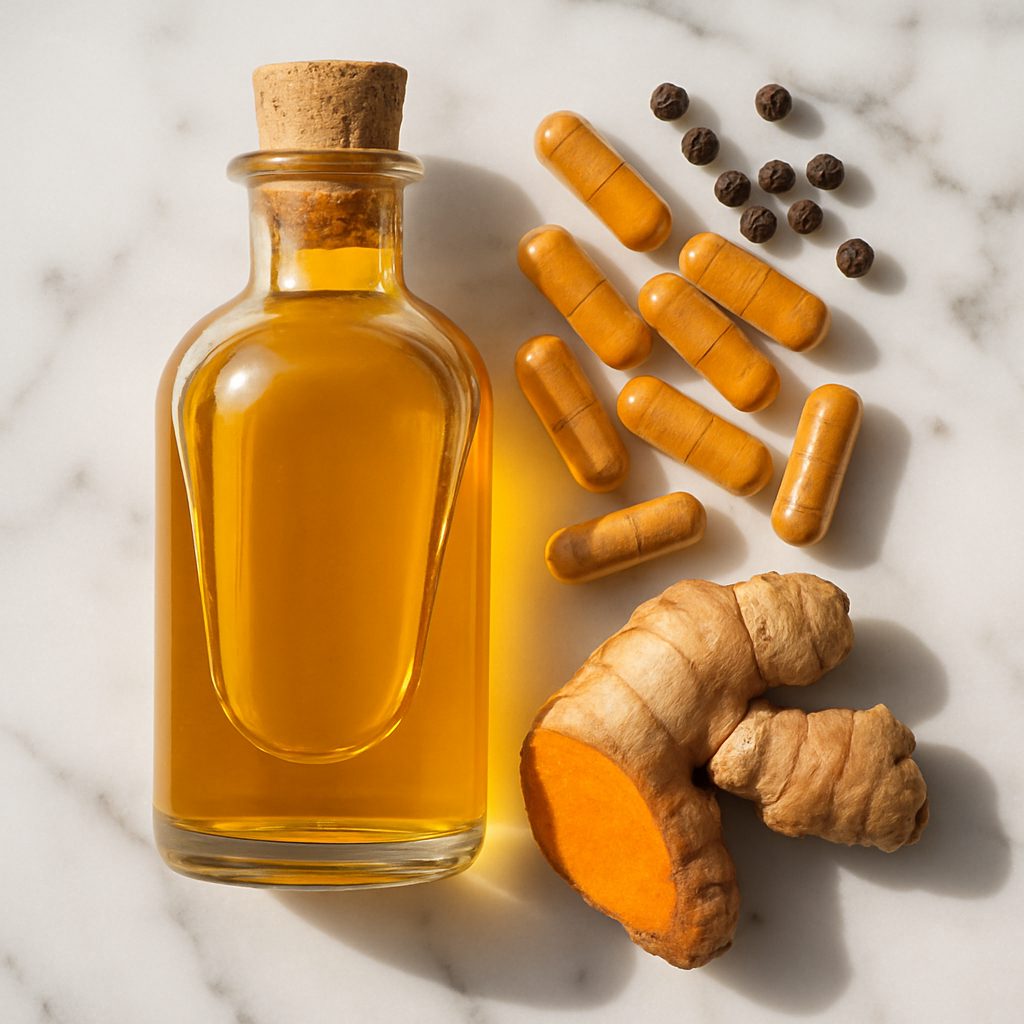
Why the Form of Your Turmeric Supplement Matters
When people first start shopping for turmeric supplements, they usually grab the cheapest bottle with the biggest number on the label. But the form turmeric comes in, and what it is combined with, matters just as much as the dose. Liquid turmeric, capsules, powders, and gummies all work differently in your body.
How Your Body Processes Curcumin
Curcumin is the main active compound in turmeric responsible for its anti-inflammatory and antioxidant effects. The problem: curcumin is poorly absorbed on its own. Studies show that plain curcumin has such low bioavailability that most of it never makes it into your bloodstream. This is why the delivery format, and what enhancers are included, is critical.
The Bioavailability Problem
A foundational study in Planta Medica (1998) established that curcumin absorption improves by 2,000% when combined with piperine (the active compound in black pepper). This discovery changed how turmeric supplements are formulated. Any product without a bioavailability enhancer is essentially wasting your money.
Liquid Turmeric: The Pros and Cons
Liquid turmeric supplements have become increasingly popular, often marketed as faster-absorbing alternatives to capsules. There is some logic here: liquids do not need to dissolve a capsule shell first, so they can theoretically reach your bloodstream more quickly.
What Liquid Turmeric Gets Right
Liquid formulas often use micronized or nano-particle curcumin, which has a smaller particle size that improves absorption. Some products use liposomal technology, encapsulating curcumin in lipid molecules that mimic the body’s natural absorption process. Studies on liposomal curcumin show absorption rates 4-5x higher than standard curcumin. Liquids are also convenient for people who struggle swallowing capsules.
Where Liquid Turmeric Falls Short
The downsides are real. Liquid turmeric products are often expensive per serving. They typically require refrigeration after opening and have shorter shelf lives than capsules. Many taste quite bitter. Without third-party testing, it is hard to verify the actual curcumin content, since quality control in liquid supplements can be inconsistent.
Capsules: Still the Most Reliable Choice
Capsules, particularly those using standardized extract with added piperine, remain the most researched and reliable delivery format. The vast majority of clinical studies on curcumin have used capsule or tablet forms with BioPerine or similar black pepper extract.
What to Look for in a Turmeric Capsule
Three things matter most when evaluating a turmeric capsule:
Standardized curcuminoid content: Look for “95% curcuminoids” on the label. Raw turmeric powder is only about 3-5% curcumin, so a standardized extract delivers a concentrated, consistent dose.
Piperine or BioPerine: This is non-negotiable if you want actual absorption. Even a small amount (5-10mg per serving) makes a dramatic difference.
Clean ingredients: Avoid products with a long list of binders, fillers, or artificial colors. Fewer ingredients means a cleaner product.
Powders and Gummies: Worth It?
Turmeric powder mixed into food or drinks (like golden milk) is fine for culinary purposes, but the curcumin dose is much lower than what you would get from a concentrated extract. It is a nice addition to your diet but not a substitute for a supplement if you are targeting specific health outcomes.
Gummies are convenient but often contain low doses and added sugars. Most gummy formulations cannot fit an effective dose without the serving size becoming impractical.
The Verdict: Which Format Wins?
For most people, a high-quality capsule with standardized curcumin extract and BioPerine is the best combination of efficacy, consistency, and value. Liposomal liquid forms can be worth exploring if capsules cause stomach discomfort, but they come at a higher cost with less research behind them.
A Product That Checks All the Boxes
Me First Living’s Turmeric Curcumin 1000mg is one of the cleaner options on the market. It uses 95% standardized curcuminoids with BioPerine for absorption, hits the 1,000mg dose that lines up with research dosages, and skips unnecessary fillers. If you have tried cheaper turmeric supplements and felt nothing, the issue is almost certainly absorption, and this formulation addresses it directly.
How Long Before You Notice a Difference?
Regardless of the format you choose, turmeric takes time. Most people notice changes in inflammation and joint comfort within 4-8 weeks of consistent daily use. Do not expect overnight results, and do not give up before the 4-week mark. Consistency matters more than any single dose.