“`html
Turmeric vs Curcumin: What’s the Difference?
People use “turmeric” and “curcumin” like they mean the same thing. They don’t. Mixing them up is one of the main reasons people buy the wrong supplement and then wonder why it isn’t working.
Here’s the actual breakdown, and why it matters for what you put in your body.
Turmeric Is the Plant. Curcumin Is the Active Compound.
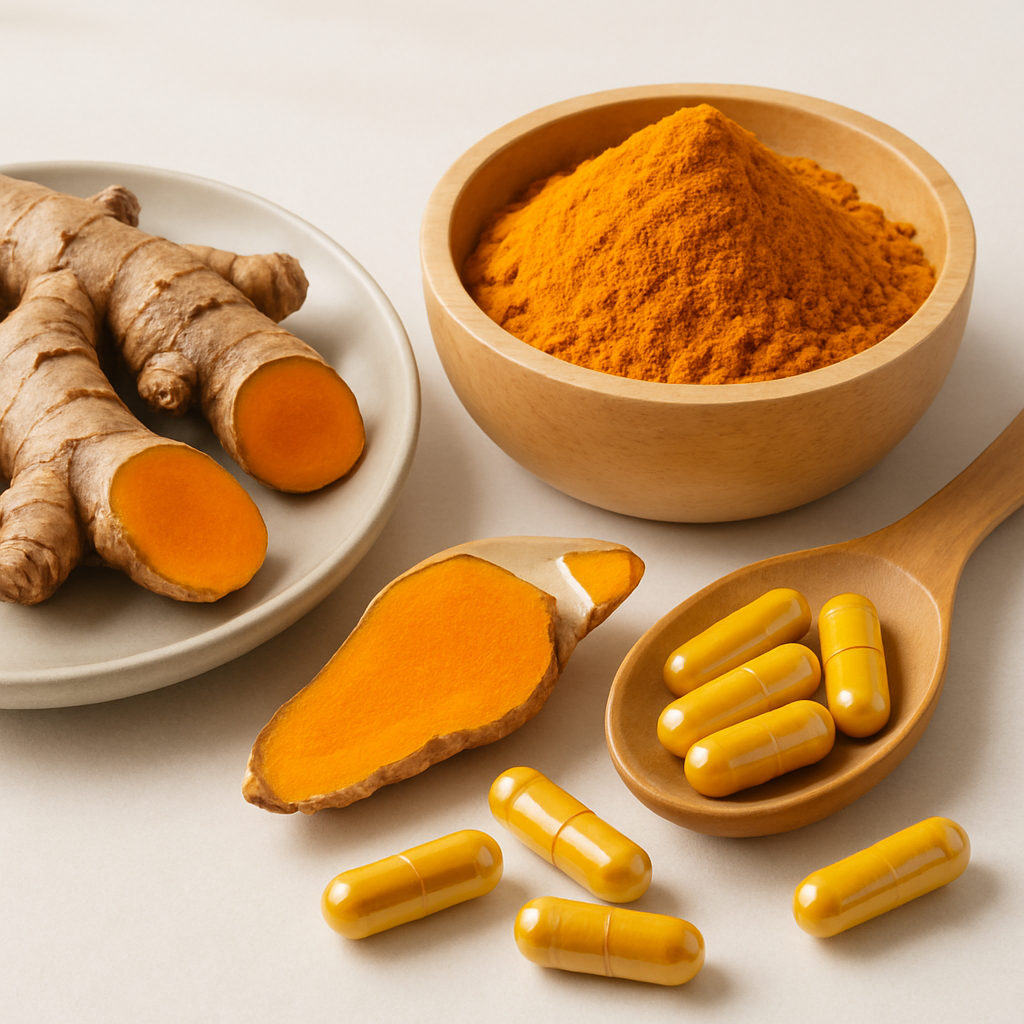
Turmeric (Curcuma longa) is a root, like ginger. The dried, ground root is what ends up in curry powder and golden milk. It has a long history in Ayurvedic medicine, going back thousands of years.
Curcumin is the primary bioactive compound found inside that root. It belongs to a family of compounds called curcuminoids, which also includes demethoxycurcumin and bisdemethoxycurcumin. When researchers say curcumin works for inflammation, joint pain, or brain health, they’re talking about curcuminoids, mostly curcumin, not the whole turmeric root. For a deeper understanding of the differences, check out this detailed comparison of turmeric and curcumin.
The critical number: turmeric root contains about 2-5% curcumin by weight. That’s it. The rest is fiber, starch, essential oils, and other plant compounds that are fine but don’t do what curcumin does.
Why Raw Turmeric Powder Falls Short
A teaspoon of turmeric powder weighs roughly 3,000mg. At 3% curcumin content (mid-range), that’s 90mg of curcumin. Most clinical trials showing significant benefits used 500-1,500mg of curcumin daily. You’d need 5-16 teaspoons of turmeric powder every single day to match what was used in those studies.
Beyond the sheer volume problem, there’s the absorption problem. Even the curcumin that exists in raw turmeric powder is poorly absorbed by the body. More on that in a moment.
Cooking with turmeric is still worthwhile. You get some curcumin, plus anti-inflammatory compounds from the rest of the plant. But if you’re trying to hit therapeutic doses, food alone won’t get you there.
What “Standardized Extract” Actually Means
When a supplement says “turmeric extract standardized to 95% curcuminoids,” it means the manufacturer has processed the root to concentrate the curcuminoid fraction up to 95% of the extract by weight.
So a 500mg capsule of 95% standardized extract delivers 475mg of actual curcuminoids. Compare that to a 500mg capsule of plain turmeric powder, which delivers 15-25mg of curcuminoids. That’s a 20-30x difference in active compound.
This is the single most important thing to check on a turmeric supplement label. If it doesn’t say “standardized to 95% curcuminoids” (or show you a specific curcuminoid mg count), you cannot know what you’re actually getting.
Many brands list turmeric root as 1,000mg or 1,500mg in large text on the front of the bottle. That big number is raw root powder or a low-concentration extract. Flip the bottle over and look at the Supplement Facts panel to see if curcuminoids are actually quantified.
The Bioavailability Problem
Here’s where things get frustrating. Even if you have a high-quality 95% curcuminoid extract, your body absorbs it poorly. Curcumin is fat-soluble and metabolized rapidly in the intestinal wall and liver. Most of what you swallow gets broken down before it reaches systemic circulation.
Studies using plain curcumin extract have shown very low plasma concentrations even after large doses. A 1997 paper in the Journal of Natural Products noted that curcumin’s low bioavailability is a major obstacle to its therapeutic use.
Researchers and supplement formulators have tried several approaches to fix this:
- Piperine (BioPerine): The most studied and widely used. Works by inhibiting intestinal metabolism of curcumin.
- Phospholipid complexes (Meriva): Curcumin bound to phosphatidylcholine. Shows 29x better absorption than standard curcumin in some studies.
- Nanoparticle formulations: Experimental, expensive, not widely available in consumer supplements.
- Fat-soluble encapsulation: Delivering curcumin in lipid matrices.
For most consumers buying off the shelf, piperine (BioPerine) is the most accessible and well-validated solution.
Why Piperine Changes Everything
The landmark study on this came from researchers at St. John’s Medical College in Bangalore. Published in Planta Medica in 1998, it showed that combining curcumin with just 20mg of piperine increased curcumin’s bioavailability by 2,000%. Later research refined this, showing that 5mg of BioPerine (the standardized piperine extract) is sufficient to achieve dramatic absorption improvement.
Piperine works by inhibiting enzymes in the intestinal mucosa that would otherwise break down curcumin before it enters the bloodstream. It also slows intestinal transit slightly, giving curcumin more time to be absorbed.
The practical takeaway: a supplement with 1,000mg of 95% curcuminoids and 5mg of BioPerine is worth significantly more than a supplement with 2,000mg of curcuminoids and no BioPerine. Absorption multiplies effectiveness.
What to Look For on the Label
Here’s a quick checklist when evaluating any turmeric supplement:
- Standardization: Turmeric extract standardized to 95% curcuminoids. Non-negotiable.
- BioPerine or piperine: At least 5mg per serving. Essential for absorption.
- Curcuminoid mg count: The actual curcuminoid content should be explicitly listed, not just the turmeric weight.
- Third-party testing: Independent verification that the product contains what it claims.
- No proprietary blends: “Turmeric blend 1000mg” where curcumin is one of ten ingredients means you have no idea what you’re actually getting.
Putting It Together
Turmeric is the pl
“`